Anovia- Just west of Madaba, along the historic road to Mount Nebo, lies Khirbat al-Mukhayyat, an archaeological jewel from the Byzantine era.
This ancient village, once home to a vibrant Christian community, is celebrated for its intricately crafted mosaics and remarkably preserved church ruins, a window into Jordan’s spiritual and artistic legacy.
Chronicled in Our Forgotten History, for the Dr Haidar Halasah, Khirbat al-Mukhayyat invites travelers to step into a world where faith, artistry, and everyday life intertwine.
The Book reveals that among the place’s treasures are several churches that showcase the village’s rich devotion and craftsmanship:
- Church of Saint George: Perched on the town’s highest point, this church was built by the renowned monk Julianus. A Greek inscription marks its dedication to Saint George during Bishop Elias’ episcopate in 536 AD.
Its mosaics, alive with floral and geometric patterns, animals, and pastoral scenes, reflect the Byzantine era’s masterful artistry. - Church of Priest John: Also attributed to Julianus, the early Christian church reveals the architectural skill and spiritual devotion of the village’s first inhabitants, standing as one of the region’s oldest sacred sites.
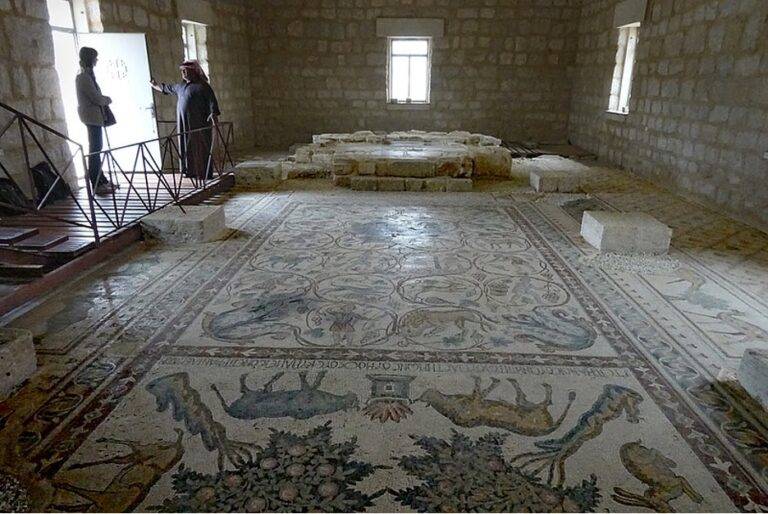
- Church of Saints Lot and Procopius: Located within the city walls, the church is protected today under a shelter that preserves its stunning mosaic floor. Dedicated to Saints Lot, the father of the Moabites, and Procopius, a martyr of Caesarea in 303 AD, inscriptions capture the personal faith of the village’s early worshippers:

“During the time of Bishop John, of great blessedness and holiness, the priest and chandelft Brichus built your sacred place and completed it in the month of November… O God of Saints Lot and Procopius, accept the offering of the brothers Stephanos and Elias, son of Comsa. O God of the martyrs, accept the offering of Sergius and his son Procopius…”
Scholar Piccirillo praises its floor as among the most beautiful mosaics in Jordan.
Evidence also suggests at least a fifth church once existed here, highlighting the village’s extensive religious network.
Archaeological excavations reveal continuous settlement and Khirbat al-Mukhayyat’s significance within the Madaba region, the renowned City of Mosaics.
Alos, the village that is situated along the King’s Highway, was a spiritual and strategic stop for pilgrims traveling to Mount Nebo and the Holy Land.
Today, Khirbat al-Mukhayyat offers more than a glimpse into history, rather a serene open-air museum. Visitors can wander among ancient walls, columns, and mosaic pavements, each telling stories of faith, artistry, and cultural exchange.
Here, Jordan’s Byzantine Christian heritage comes alive, offering a journey as enriching as it is unforgettable.