Exploring 34 sites that illuminate Jordan’s place in Biblical history and the development of Christianity
Dr. Rula Samain
History survives in geographical places, ancient texts, archaeological discoveries and the religious traditions that communities have carried across generations.
In Jordan, these different forms of historical memory intersect with particular significance. The country’s landscape contains places associated with the earliest Biblical narratives, the life of Jesus Christ, the beginnings of Christian pilgrimage and the development of some of the region’s first Christian communities.
Yet Jordan’s contribution to Christian history cannot be understood through individual sacred sites alone. Its importance lies in the historical continuity connecting the Biblical world, the Byzantine and early Islamic periods.
Archaeological evidence reveals not only the construction of churches and monasteries, but also the emergence of organised communities with distinctive artistic, educational, religious and economic traditions.
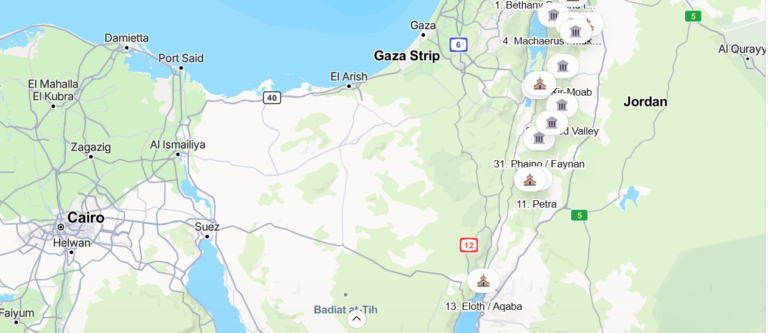
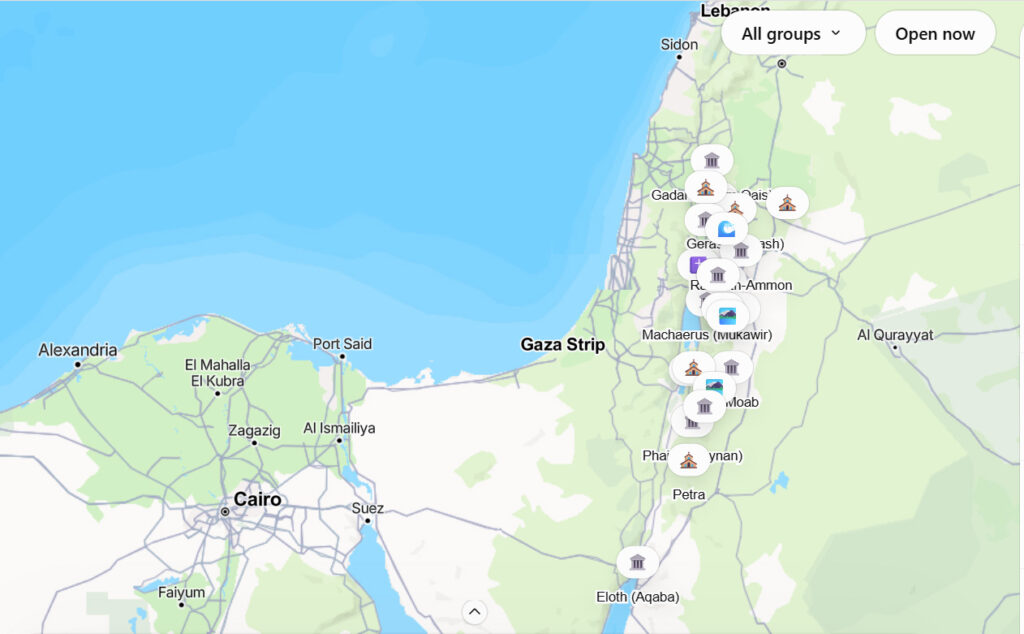
According to the Jordan Tourism Board there are 34 Biblical and Christian heritage locations across the Kingdom. Some preserve substantial archaeological remains; others are identified through Scripture, historical geography or longstanding religious tradition.
Viewed collectively, the sites provide a compelling perspective on Jordan’s place within the wider history of the Holy Land.
The foundations of Christian pilgrimage
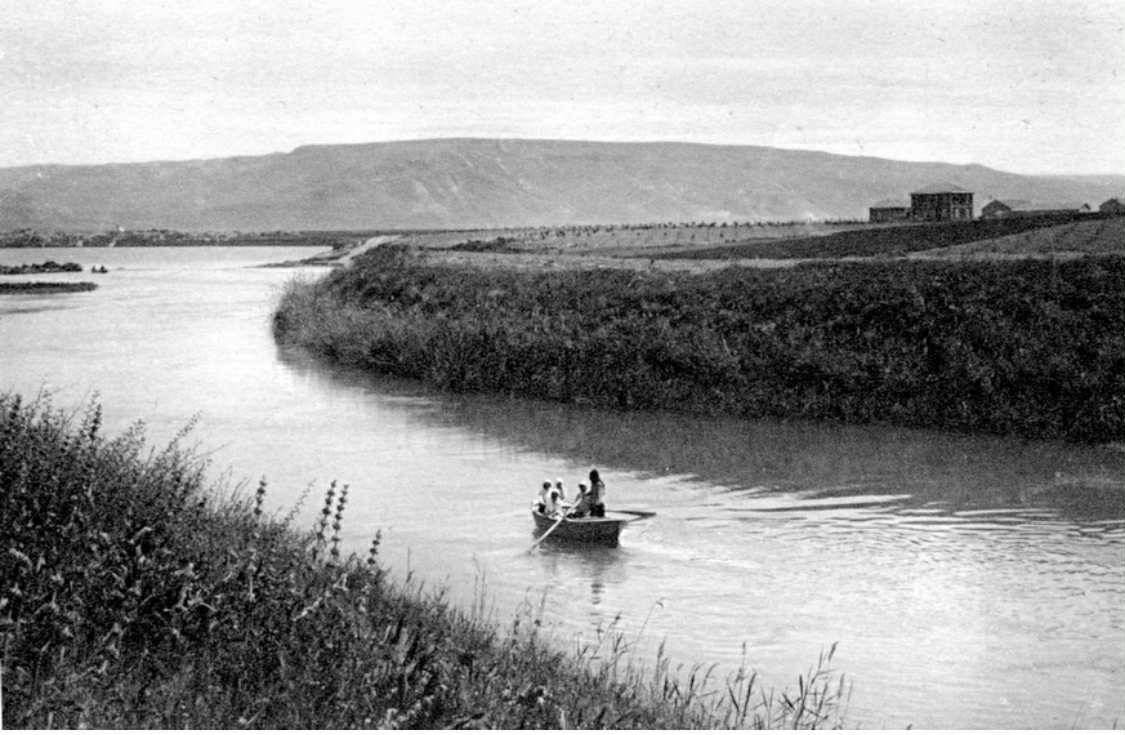
The Baptism Site (Bethany Beyond the Jordan) also named Al-Maghtas occupies a central position in Christian tradition as the location of Jesus Christ’s baptism by John the Baptist (John 1:28; Matthew 3:13–17). Archaeological excavations have uncovered churches, baptismal pools and monastic structures, confirming centuries of Christian pilgrimage and veneration.
Mount Nebo, associated with Moses’ final view of Holy Land (Deuteronomy 34:1), became an important Byzantine pilgrimage destination. Its churches and mosaics provide evidence of organised monastic life.
Madaba, renowned for its sixth-century mosaic map of the Holy Land, preserves a remarkable expression of Christian geographical knowledge. The map is simultaneously a work of art, a historical document and a representation of sacred geography.
Machaerus (Mukawir) is associated with the imprisonment and execution of John the Baptist (Mark 6:17–29). Significantly, the first-century historian Flavius Josephus identifies the fortress as the place of John’s death, providing an important historical source independent of the Gospels.
In northern Jordan, Tell Mar Elias, traditionally associated with the Prophet Elijah, preserves Byzantine church remains, while Our Lady of the Mountain in Anjara represents an enduring devotional tradition associated with the Virgin Mary and the Holy Family.
Umm ar-Rasas, recognised by UNESCO, contains 16 churches. Its exceptional mosaic floors, particularly that of St Stephen’s Church, demonstrate the artistic sophistication and religious vitality of Christian communities during the Byzantine and early Islamic centuries.
Northern Jordan: The development of Christian cities
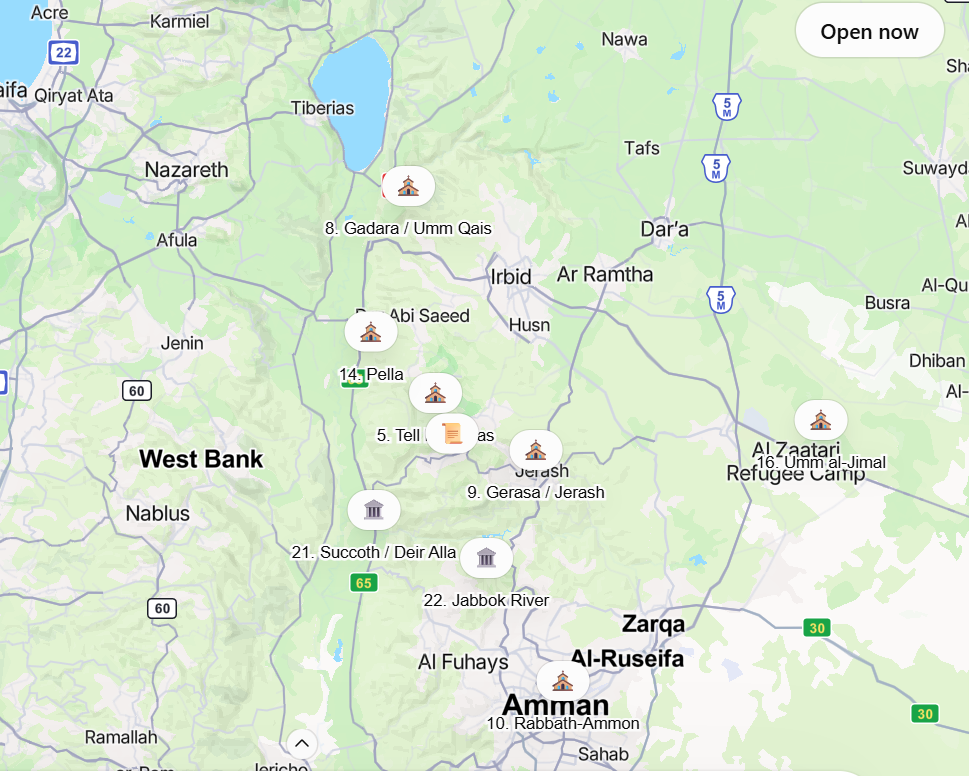
The ancient Decapolis cities offer substantial evidence of Christianity’s institutional development.
Gadara (Umm Qais), associated with Gospel traditions concerning the Gadarene region (Matthew 8:28–34), preserves Roman and Byzantine remains.
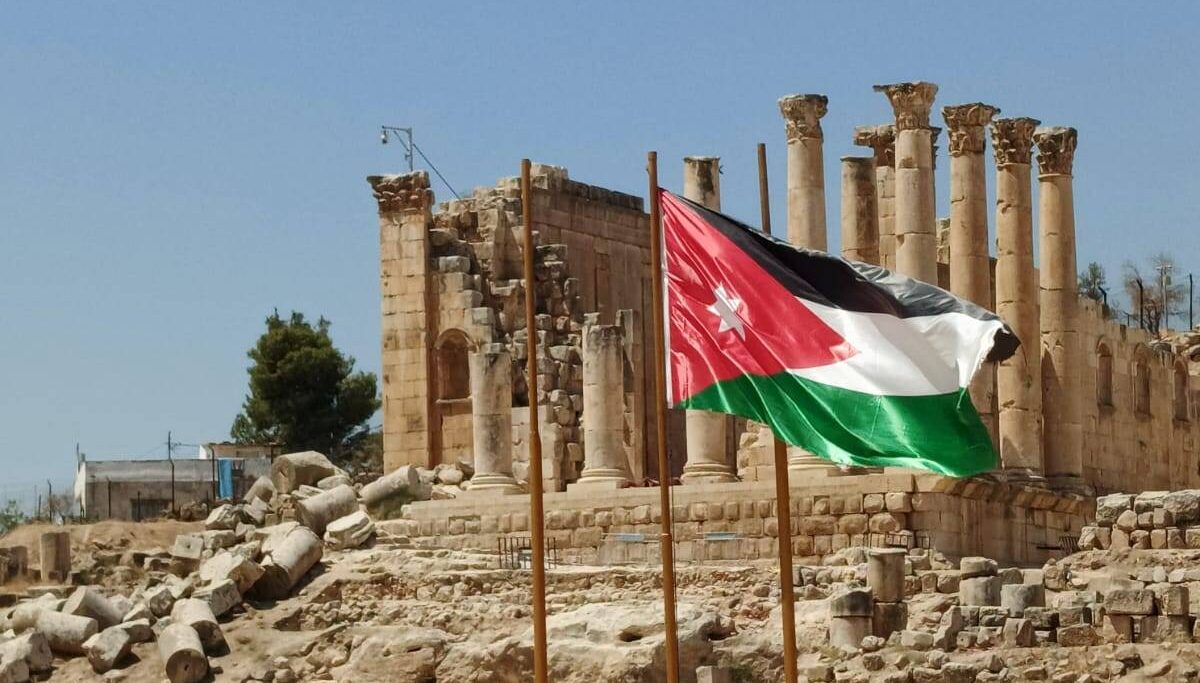
Gerasa (Jerash) developed into a significant Christian urban centre. Its cathedral and numerous churches reveal the architectural transformation of the city during Late Antiquity.
Rabbath-Ammon (Amman), subsequently known as Philadelphia, became an episcopal centre, while Pella (Tabaqat Fahl) preserves churches and other evidence of Christian urban life.
Umm al-Jimal, now a UNESCO World Heritage Site, contains 16 churches constructed within its distinctive basalt-built settlement. Together, these monuments reveal Christianity’s presence beyond major urban centres.
Other northern locations illuminate the older Biblical geography of Transjordan. Ramoth-Gilead appears in accounts of ancient conflicts (1 Kings 22); the Brook Cherith is associated with Elijah (1 Kings 17); and Jabesh-Gilead figures in the history of Saul (1 Samuel 11).
Zaphon, Rehab and Succoth (Deir Alla) reflect the settlement geography of the Jordan Valley, while the Jabbok River, traditionally identified with the Zarqa River, recalls Jacob’s encounter described in Genesis 32.
Their importance lies primarily in reconstructing the geographical and cultural world of the Biblical texts, although several precise identifications remain debated.
Central Jordan: Kingdoms, boundaries and ancient testimony
The central plateau preserves evidence of civilizations that preceded Christianity and shaped the region’s historical identity.
Heshbon (Hisban) is associated with King Sihon in Numbers 21. Dibon (Dhiban) is particularly important as the discovery place of the ninth-century BC Mesha Stele, which provides an independent account of the ancient Moabite kingdom.
Aroer and the Arnon Valley (Wadi Mujib) appear in Biblical descriptions of territorial boundaries, while Kir-Moabfeatures in prophetic literature, notably Isaiah 15.
These locations place Biblical accounts within a wider historical setting of kingdoms, trade routes, political rivalries and changing territorial relationships.
The Dead Sea and southern landscapes
The region surrounding the Dead Sea contains sites associated with some of the Old Testament’s best-known narratives.
Sodom and Gomorrah remain subjects of archaeological investigation and competing geographical interpretations. Zoar (Ghor es-Safi) is associated with Lot’s escape, while nearby Lot’s Cave preserves the remains of a Byzantine monastic complex, confirming the area’s later importance in Christian religious memory.
The Zared Valley (Wadi Hasa), and fuarther south, Phaino (Faynan) provides evidence of extensive ancient copper production.
Sela and Buseira, associated with Edomite history, illuminate the political and cultural landscape of southern Transjordan before the Christian era.
Petra and the southern Christian legacy
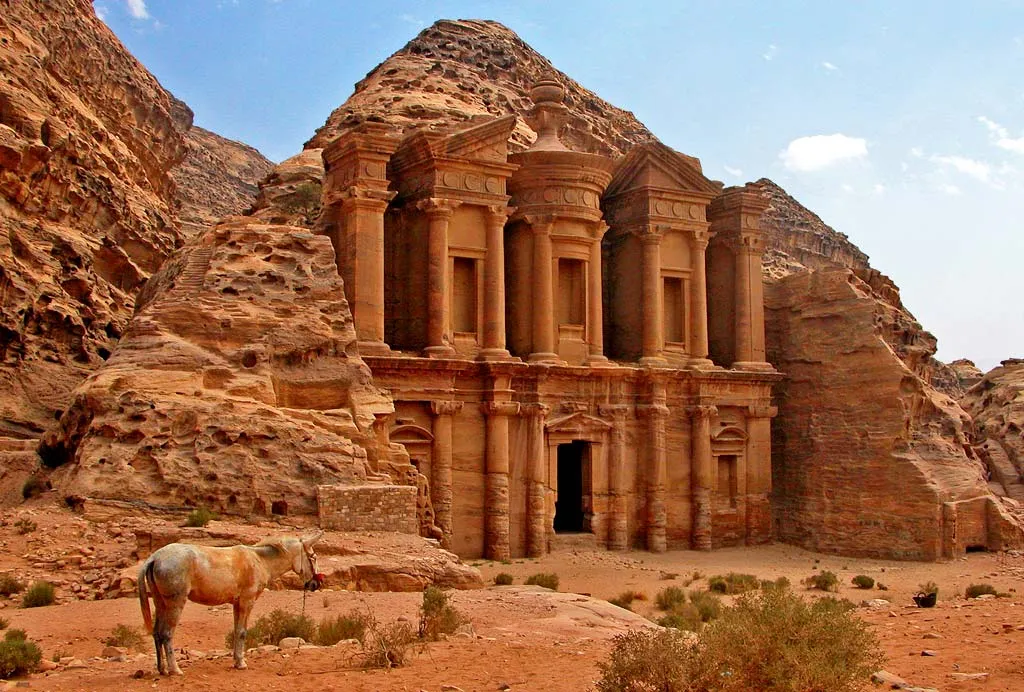
Although internationally celebrated for its Nabataean architecture, Petra also developed into an important Christian centre. Excavated churches, elaborate mosaics and the sixth-century Petra papyri provide exceptional evidence of ecclesiastical institutions, property ownership and everyday life.
Eloth (Aqaba) preserves remain of an early purpose-built church, demonstrating Christianity’s presence along the historic Red Sea trading routes.
Finally, Mount Hor (Jabal Aaroun), traditionally associated with Aaron’s burial (Numbers 20:22–29), contains archaeological remains of a Byzantine monastic complex that attest to its later significance as a pilgrimage destination.
Beyond the monuments- Understanding Jordan’s Christian inheritance
The significance of Jordan’s 34 Biblical and Christian heritage locations is measured by their antiquity, as well as religious associations or archaeological remains. Their deeper importance lies in what they reveal collectively that is the territory in which successive civilizations interacted, religious traditions developed, and Christianity became an established component of society.
Importantly, the archaeological record also documents Christian communities continuing their religious and cultural activities during the early Islamic period. This historical continuity challenges simplistic accounts that portray the region’s past as a succession of disconnected civilizations. It instead invites a more careful understanding of cultural transformation, adaptation and shared historical experience.
As Jordan prepares to commemorate the 2,000th anniversary of the baptism of Jesus Christ in 2030, the occasion presents an opportunity to bring this broader heritage into international focus.
Al-Maghtas will naturally stand at the centre of the commemoration. Yet understanding its significance requires looking beyond the baptismal waters to the wider landscape of churches, ancient settlements, Biblical locations and living communities.
For Jordan, preserving and communicating this heritage is therefore more than an undertaking in religious tourism, but an intellectual and cultural responsibility in order to present the country’s history with scholarly integrity, to acknowledge the depth of its Christian inheritance, and to demonstrate how the historical experience of different faiths has contributed to its national identity.
Principal references
- The Bible: Genesis 19 and 32; Numbers 20–21; Deuteronomy 34; 1 Samuel 11; 1 Kings 17 and 22; Isaiah 15; Matthew 3, 8 and 14; Mark 6; John 1.
- Mohammad Waheeb (2001), Recent Discoveries East of the Jordan River: Wādī al-Kharrār Archaeological Project, Annual of the Department of Antiquities of Jordan, 45, pp. 419–426.
- Department of Antiquities of Jordan (1996), Petra Church Project, Petra Papyri, Annual of the Department of Antiquities of Jordan, 40.
- UNESCO World Heritage Centre, Al-Maghtas, Umm ar-Rasas, and Umm al-Jimal.
- Jordan Tourism Board, Biblical Jordan — official inventory and map of the 34 heritage locations.