
By Rula Samain
The Jordanian narrative, whose significance has been clearly articulated by His Royal Highness Crown Prince Hussein bin Abdullah II, is neither a theoretical construct nor a broad, abstract slogan, rather a lived reality, present in the details of everyday life: in public conduct, institutional culture, the way challenges are managed, and the values of work, belonging, and responsibility, and manifests across education, media, the economy, culture, social relations, and tourism.
In its contemporary sense, the “tourism narrative” goes well beyond a promotional brochure or a checklist of sites. It is the story of a nation, shaped through both tangible and intangible elements: place and people, history and civilization, experience and emotion, meaning and memory, set on a land that continues to surprise the world with what has been revealed and what remains undiscovered.
The story begins with the Jordanian people; hospitality, warmth of welcome, and a natural readiness to assist and guide the stranger are not merely social traits; they are integral components of the visitor experience and a core pillar of what is today described as the “experience economy.”
This human dimension is reinforced by a strong educational ethos. Jordan has become a preferred destination for Arab and international students alike, hosting more than 55,000 international students from 119 countries. This reflects confidence in the Kingdom’s academic infrastructure and social stability, and strengthens Jordan’s image as a hub of knowledge, dialogue, and openness.
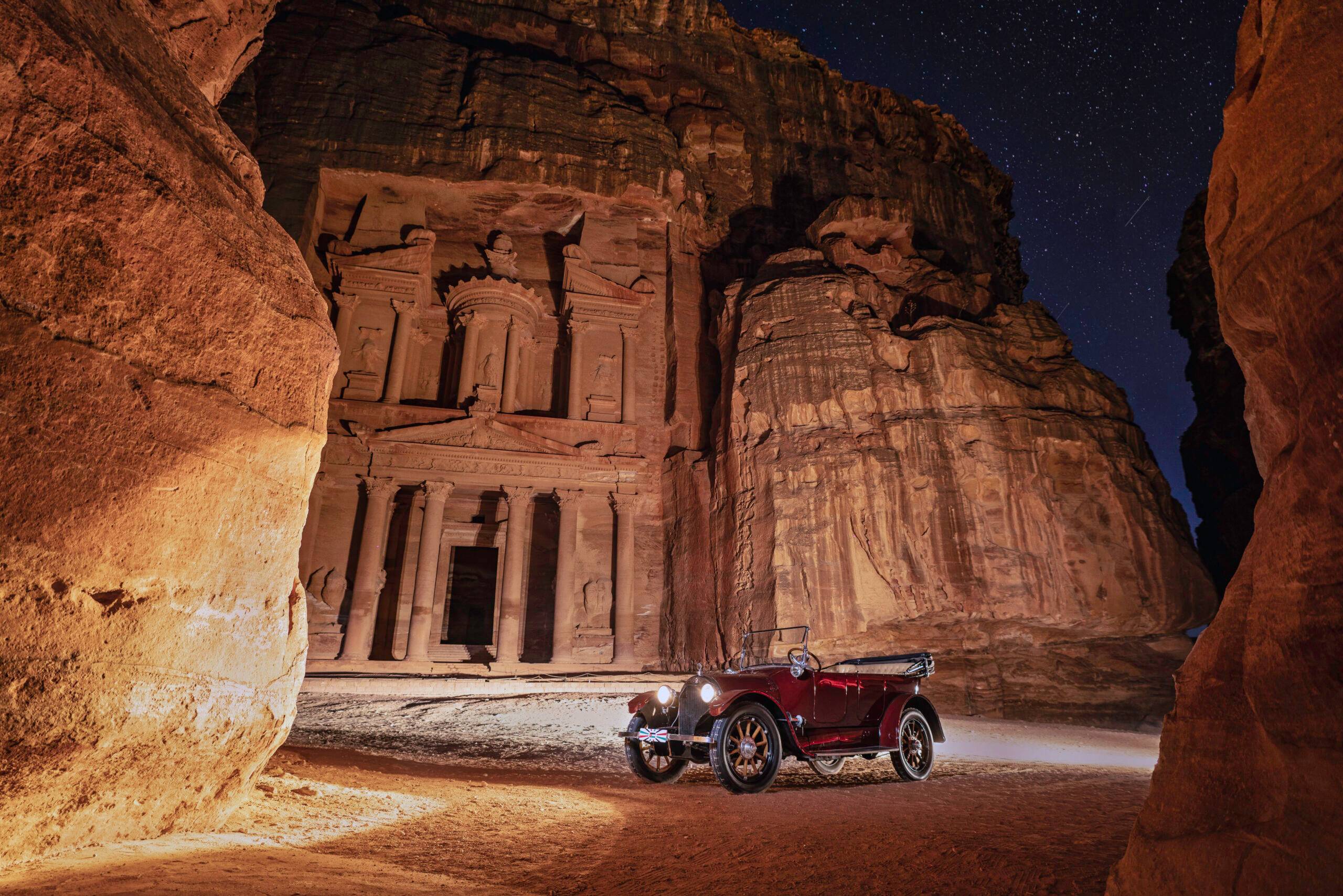
The land itself is an open text of civilizations. In the south, Petra stands as an icon of the Jordanian narrative, a city carved in stone and recognized as one of the New Seven Wonders of the World in 2007.
Today, Petra is not presented as a static archaeological site, but as a living, evolving experience. Developments such as “Petra by Night,” improved visitor trails, and innovative presentation technologies reflect an approach that bridges legend with innovation while preserving the spirit of place.
The spiritual dimension occupies a profound space within this narrative through religious sites that form part of humanity’s shared memory. From the Baptism Site on the River Jordan, inscribed on the UNESCO World Heritage List, to Mount Nebo, where faith meets history and geography, religious tourism is not framed as a separate niche. Rather, it is embedded in the identity of a land historically known as the “Holy Land,” a crossroads of revelations, prophets, pilgrimage routes, and a lived tradition of diversity.
Nature, too, adds its own layers to the story. The Dead Sea offers a singular experience as the lowest point on Earth and a global destination for wellness, healing, and contemplation. Aqaba provides the maritime chapter of the narrative, with its rich coral reefs and striking biodiversity, completing the picture of a country that unites desert and sea within a compact geography.
Northern cities are no less compelling: Ajloun presents a model of eco-tourism where forests and hiking trails intersect with history; Irbid emerges as a vibrant city of knowledge and culture shaped by university life; and Jerash stands as a living lesson in open-air archaeology, a meticulously preserved Roman city that allows visitors to walk through time rather than merely observe it.
While these exceptional places, and many, form the backbone of Jordan’s tourism narrative, presenting them to the world should not be limited to recounting history or enumerating successive civilizations.
What is required today is the crafting of a contemporary narrative grounded in visitors’ needs, expectations, and interests. Sites, however great their historical value, achieve their full appeal only when framed within a human-centered, experiential narrative, one that reflects the spirit of place, connects past and present, and transforms a visit from static knowledge into a living, meaningful experience.
From this perspective, visiting Jordan is not a fleeting stop, but an experience inherently long-term in nature. It is a country not meant to be rushed, but explored deliberately, contemplated in its details.
To visit Jordan is to walk the Holy Land and to live a holistic human experience, one in which the visitor realizes that what has been seen is only part of the story, and that the true narrative of this country does not end with a single visit, but begins with it.
Journalist &writer specialized in interfaith dialogues, peace and reconciliation, Anovia CEO