Anovia, Amman — In a healthcare landscape steadily advancing toward precision and specialization, medical laboratories are no longer confined to the role of diagnostic testing facilities, but have become a decisive force in medical decision-making and a fundamental pillar within an integrated treatment ecosystem.
This transformation is clearly embodied in the experience of PMLAB, which has developed an advanced laboratory model built on the integration of cutting-edge technology with human expertise.
Its services extend across routine, specialized, and advanced field; from biochemistry and hormones to hematology and oncology diagnostics, and up to high-precision genetic testing.
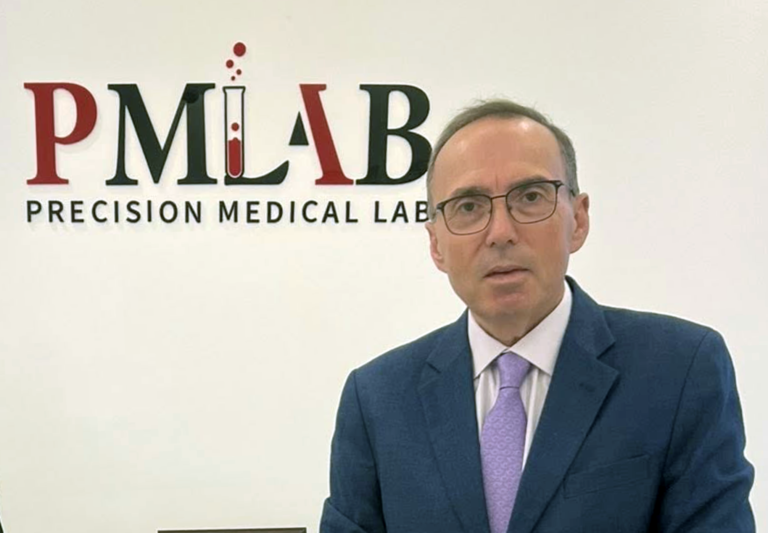
Anovia Magazine held an exclusive interview with the founder of PMLAB, Dr. Bashar Al-Qsous, who offered a comprehensive perspective on the evolving role of laboratory medicine within the healthcare system, emphasizing that “the current phase requires moving beyond the traditional concept of laboratories toward a more integrated and influential role in the diagnostic and therapeutic process.”
Al-Qsous, also the President of the Jordanian Association of Medical Laboratory Specialists, noted that this evolution “did not emerge overnight,” but is the result of sustained investment in both technological infrastructure and human capital.
He explained that “laboratory work today relies on the latest technologies, including artificial intelligence, within a system led by highly qualified physicians and technicians.”
He added that this progress has positioned laboratories at the forefront of an increasingly competitive and rapidly developing healthcare environment in Jordan.
This advancement comes within a broader context tied to Jordan’s growing prominence in medical tourism.
According to Dr. Al-Qsous, the Kingdom “has become a leading destination for patients from the Gulf region and the Mediterranean basin, owing to its well-established medical reputation and services that meet international standards.”
He stressed that laboratory quality is a cornerstone of this system, noting that “advanced medical care, supported by accurate diagnostics, is the decisive factor in attracting international patients and strengthening their confidence in Jordan’s healthcare sector.”
He further emphasized that advanced laboratory services play a pivotal role, directly enhancing the trust of incoming patients and supporting a comprehensive treatment experience based on precision and efficiency.
In the field of genetic diagnostics, the scale of transformation becomes even more apparent.
Dr. Al-Qsous highlighted that PMLAB was among the first institutions to introduce genetic testing technologies in Jordan, drawing on international expertise acquired since the early 2000s.
“We began working in this field at the start of the new millennium after specialized training in leading global centers, and we succeeded in transferring this expertise to Jordan, enabling us to conduct advanced tests such as exome and genome sequencing,” he said.
Excellence in this area extends beyond testing itself to encompass a comprehensive framework of genetic counseling before, during, and after testing, in close collaboration with treating physicians.
Dr. Al-Qsous underscored that “involving the physician at every stage of the testing process enhances the accuracy of results, reduces unnecessary procedures, and ensures a scientifically precise diagnosis that directly serves the patient.”
The concept of personalized medicine stands out as one of the most significant shifts in modern medical practice.
Dr. Al-Qsous explained that this approach is centered on answering a fundamental question: “Is this treatment the most suitable for this particular patient?” The answer, he noted, lies in analyzing genetic and biochemical data, enabling the selection of the most appropriate treatment and dosage, as well as more accurate predictions of patient response, an approach contributes to reducing complications and avoiding ineffective therapies.
“The shift from generalized treatment decisions to individualized ones based on a patient’s genetic profile represents a qualitative leap in healthcare,” he stated, and affirmed that PMLAB places this concept at the core of its strategy, particularly in managing chronic diseases, where genetic diagnostics allow for identifying the optimal treatment from the outset, rather than relying on trial-and-error approaches.
Field laboratories have also emerged as a key innovation redefining the relationship between patients and healthcare services, particularly in the aftermath of the COVID-19 pandemic.
Dr. Al-Qsous explained that “mobile laboratory services have become essential, enabling access to patients across various regions, including remote areas, while maintaining the same quality standards as in-lab services.”
He added that these services extend to homes, companies, and factories, reflecting laboratories’ ability to adapt to societal needs and deliver flexible, comprehensive solutions.
On the challenges front, Dr. Al-Qsous described the laboratory sector as fundamentally engaged in a “technological and time-driven race,” requiring continuous alignment with the latest innovations, especially with the integration of artificial intelligence.
“Any delay in adopting these technologies results in a decline in competitiveness, both locally and regionally,” he warned.
Dr. Al-Qsous emphasized that collaboration with universities and research institutions is a critical component of this trajectory, contributing to the advancement of scientific research and the enhancement of service quality for both researchers and patients.
He added that PMLAB’s ambitions extend beyond the domestic market to regional and international competition, reinforcing Jordan’s position as a leading hub for advanced medical and laboratory services.
Linking sector development to the broader national vision, Dr. Al-Qsous stressed that “raising the standards of all laboratories in Jordan and strengthening quality and accreditation frameworks is a strategic objective aligned with national directives toward innovation and excellence.”
Achieving this goal, he concluded, would move Jordan from delivering advanced healthcare services to shaping an integrated, innovation-driven model, further solidifying the Kingdom’s status as a premier destination for medical tourism regionally and globally.