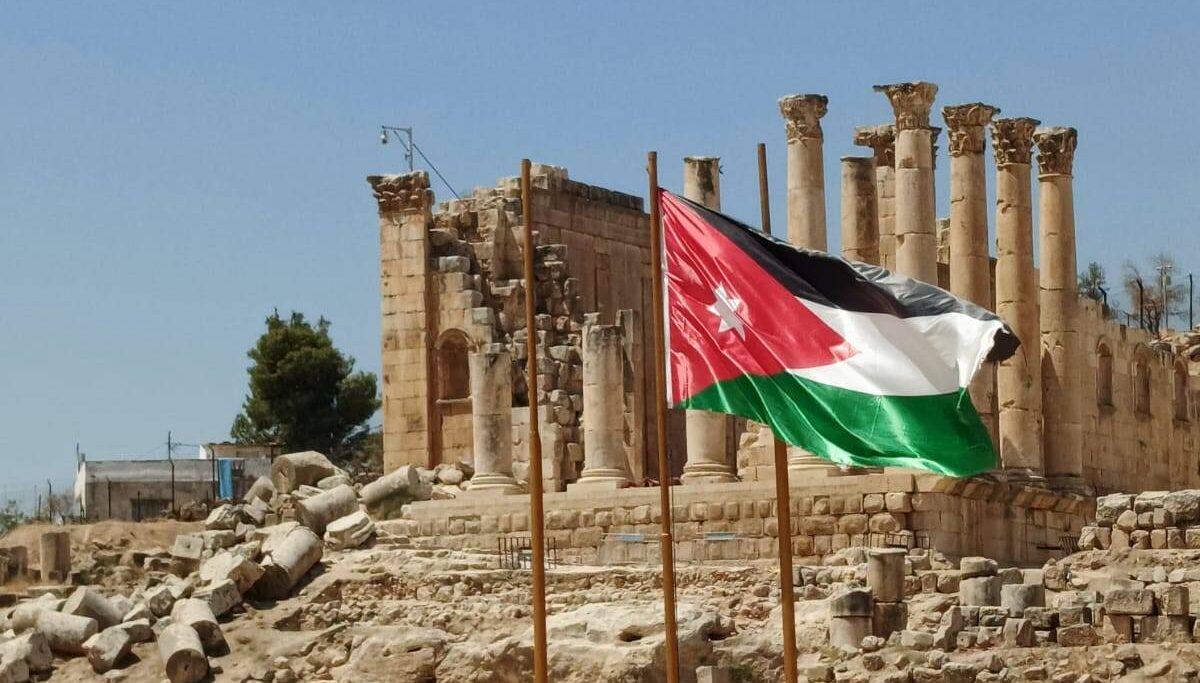
Anovia — The monument known as Jerash Cathedral, located near the Cardo Maximus and beside the Sanctuary of Artemis, is one of the key surviving structures for understanding the development of Christianity in ancient Gerasa (Jerash), occupying a prominent position within the city’s monumental centre.
For much of the twentieth century, the Cathedral was generally dated to the fourth century, making it one of the earliest monumental Christian churches in the region.
Later archaeological investigations revised that interpretation.
Research conducted through the Jarash Cathedral Project in the 1990s indicated that the basilica was more likely constructed around the end of the fourth century or, more probably, during the first half of the fifth century.
The revised dating places the church within a period when Christianity had already become increasingly established in the public and architectural life of Gerasa.
The Cathedral was built as a three-aisled basilica, with a central nave, side aisles and an eastern sanctuary with scale and location reflecting the growing visibility of Christian institutions in the city during Late Antiquity.
____________________________________________________________________________
“The Cathedral of Jerash is mentioned in every handbook of early Christian architecture.” Carola Jäggi, Hans-Rudolf Meier and Beat Brenk
____________________________________________________________________________
It also formed part of a wider Christian architectural zone; immediately to its west was the Fountain Court, while the Church of St Theodore stood farther beyond it.
The church occupied an earlier Roman site. Archaeological work confirmed the remains of a Roman podium temple beneath it, traditionally associated with Dionysus, although the dedication has not been conclusively established.
Roman architectural elements were also reused in the construction of the later basilica.
Modern research has paid particular attention to the Cathedral’s relationship with the neighbouring Sanctuary of Artemis. A 2021 study by archaeologist Ian Elliot McElroy examined how the Christian complex developed within the existing monumental framework of Gerasa, showing continuity in the use of the city’s central spaces.
Archaeological evidence includes mosaic and decorative remains, indicating that parts of the interior were once more richly finished. The surviving stone walls and columns therefore preserve only part of the church’s original visual character.
Gerasa is known to have had bishops from at least the fourth century, confirming the presence of an established Christian community and ecclesiastical administration.
____________________________________________________________________________
“Gerasa was a flourishing provincial Roman city that became a major Christian centre in the Byzantine period.” David D. Boyer
____________________________________________________________________________
The Cathedral underwent changes.
Evidence of burning and damaged mosaic material suggests that the church suffered destruction or fire during a later period, while subsequent modifications altered parts of the nave, sanctuary and floor levels.
These changes indicate continued use, repair and adaptation over time.
Within the wider archaeology of Jerash, the Cathedral remains important because it documents the development of Christian architecture in the city across several phases.
____________________________________________________________________________
“The cathedral was integral to how Christianity was monumentalized in Gerasa.” an Elliot McElroy
____________________________________________________________________________
Its location, basilical form, decorative remains, later alterations and relationship with neighbouring churches provide important evidence for the scale and organisation of Christian Gerasa during the Byzantine period.
For visitors today, it remains one of the clearest surviving architectural witnesses to Jerash’s development as a major Christian urban centre in Byzantine Jordan.