Talal Al-Sukkar
Media Representative
Anovia – In the southeast of Amman, where the modern city intertwines with deep layers of history, stands a stone monument that refuses to be merely the remains of a distant past.
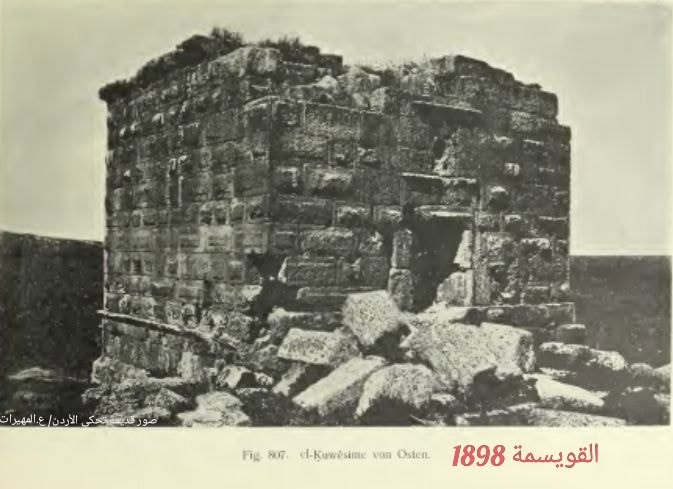
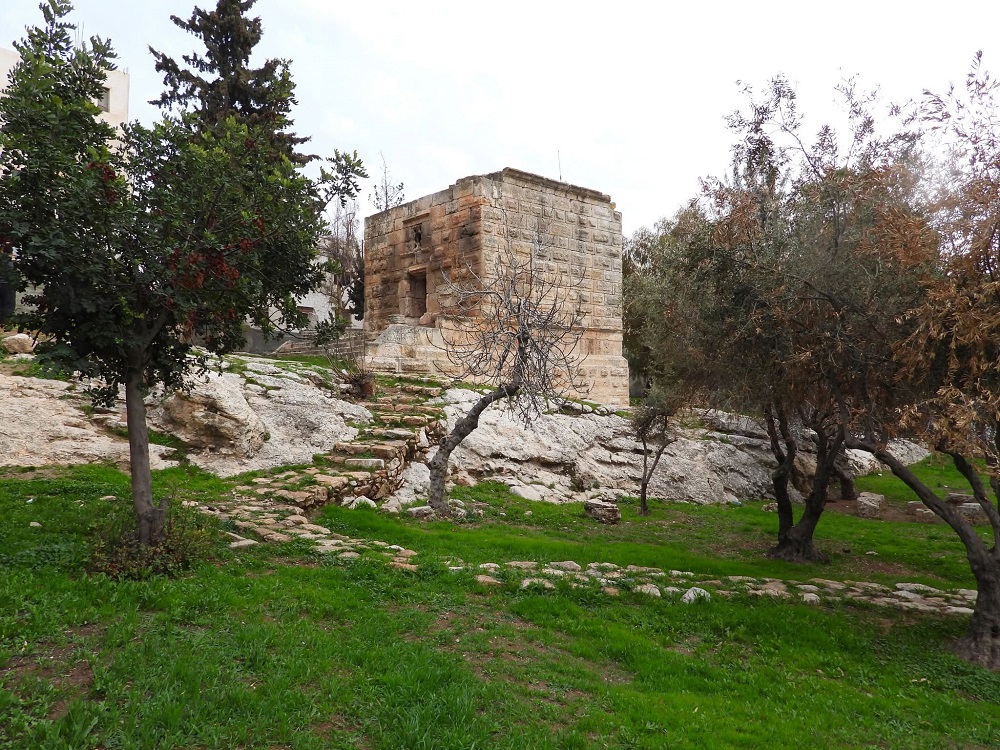
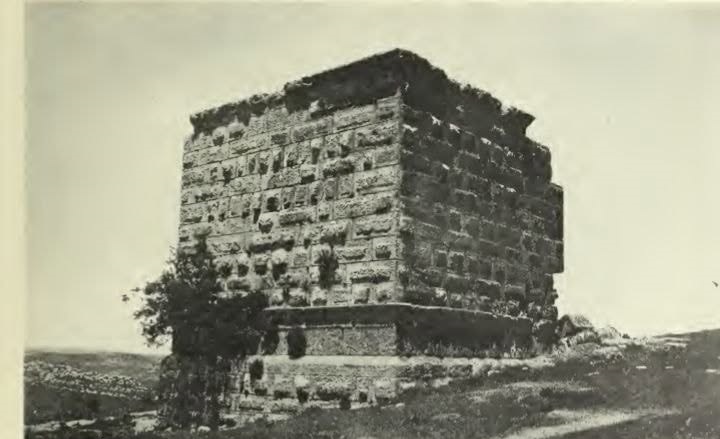
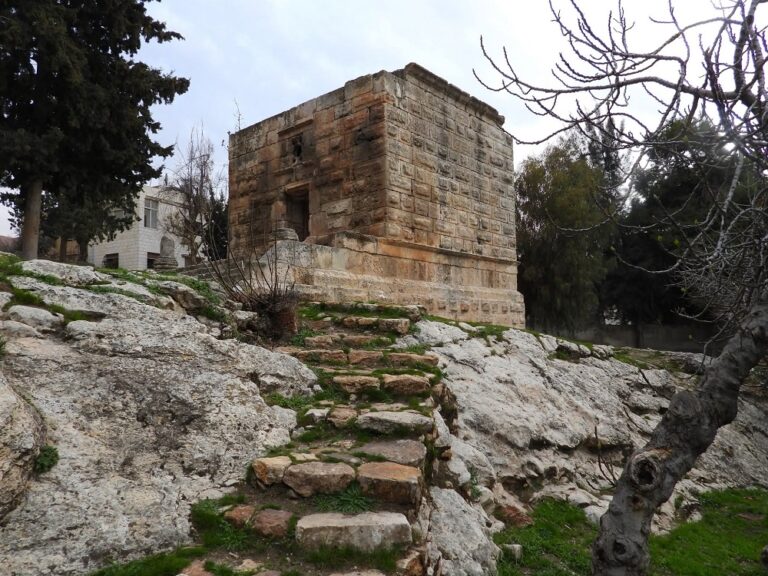
It is the Al-Quwaysimah Tomb, known among the people as Qasr Al-Sab‘a or Qasr Al-Siba‘; an ancient Roman building that has remained a witness to successive centuries and to empires that rose and then bowed before time.
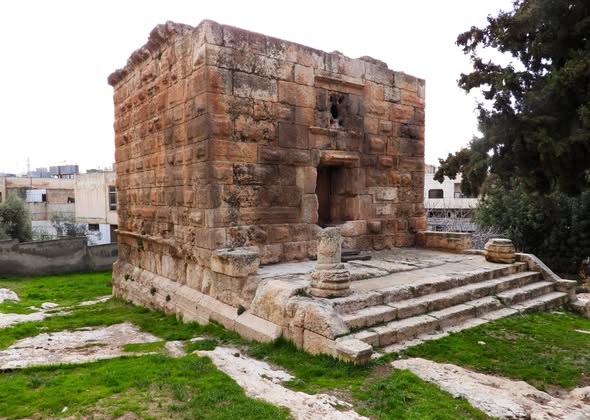
It is not a palace in the sense suggested by the word, nor a military fortress, but rather a Roman funerary tomb dating back to the second century AD, which served as a family burial place that housed members of one family. Over the centuries, its architectural grandeur, location, and the name given to it by the people have given it a special place in Amman’s collective memory.
This is not merely an old stone.
This is history standing on the ground.
From Philadelphia to Al-Quwaysimah
When the tomb was built, Amman was known as Philadelphia, and it was part of the Roman world that left deep marks across the Levant.
At that time, roads crossed the region, trade moved between cities, and families built their burial places outside residential centers. Tombs were not merely places for burying the dead; they were an expression of the family’s status, memory, beliefs, and understanding of death and immortality.
Within this context, the Al-Quwaysimah Tomb emerged as a place where the family preserved the memory of its dead and practiced rituals associated with honoring those who had passed away.
The building remained standing while everything around it changed.
The names of cities changed, empires fell, trade routes changed, and new eras came, but the stone continued to carry the memory of the age in which it was built.
Architecture That Carries the Majesty of Time
The tomb does not rely on the grandeur of palaces or the towers of fortifications. Its strength lies in its simplicity and solidity.
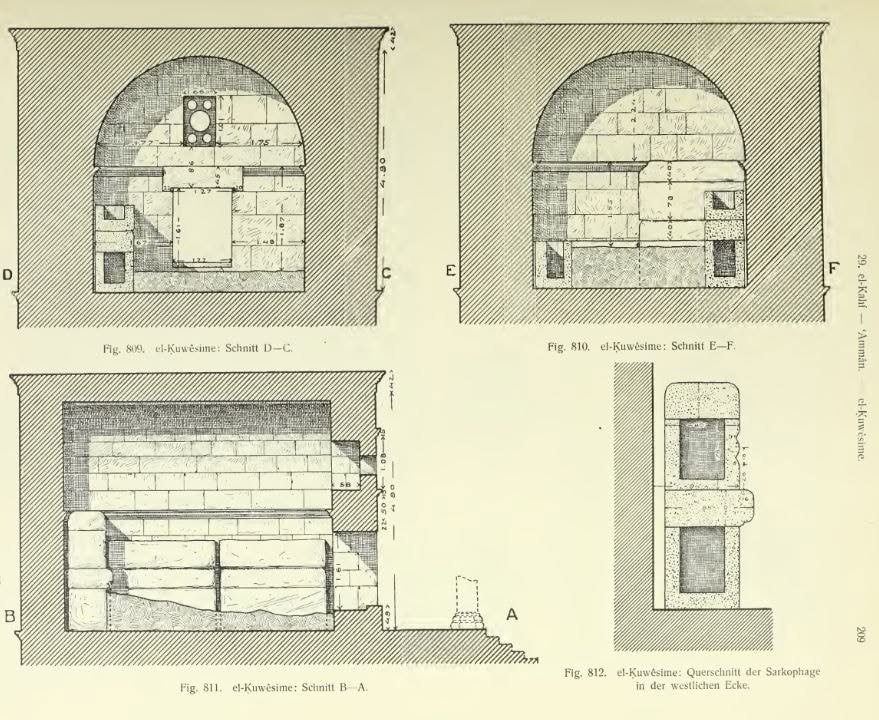
The building is rectangular in shape, topped by a vault or barrel roof, with its entrance located on the northern side. These elements may appear simple at first glance, but to archaeologists they carry meanings related to construction techniques and the function for which the building was designed.
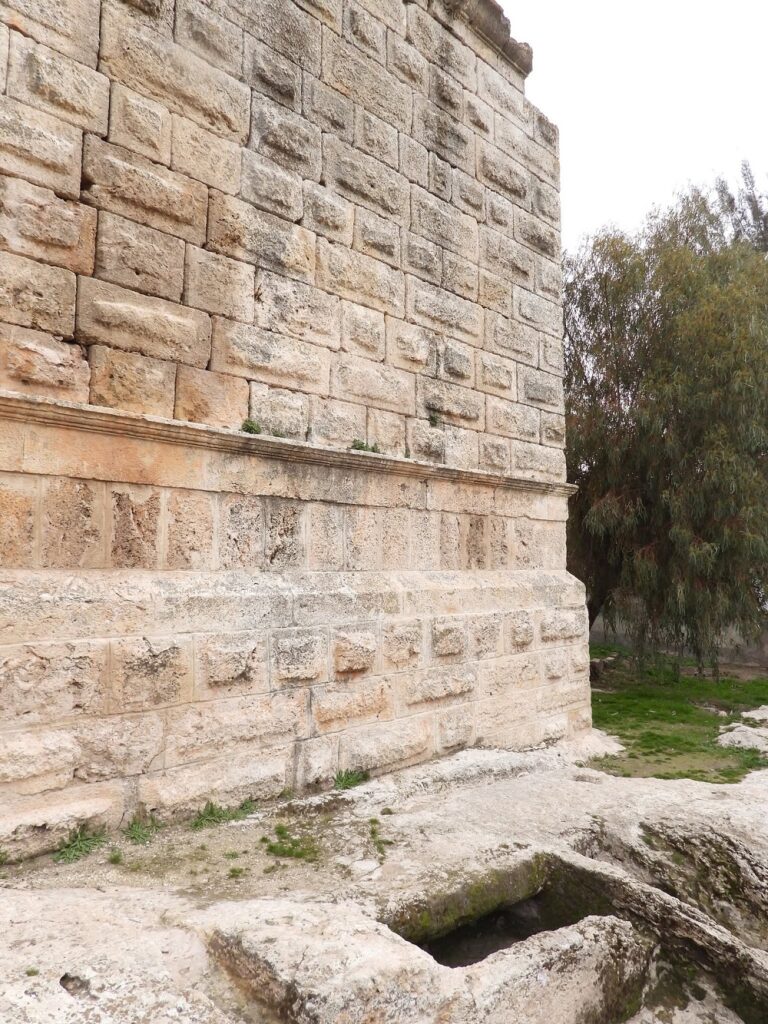
The tomb did not stand alone. Its surroundings contain Roman rock-cut tombs, along with other remains that make the site part of a broader funerary landscape.
Here, the rock itself becomes a document.
Every cavity, every block of stone, and every mark carved into the site can be a line in a book that was not written with ink, but written in stone.
Why Was It Called Qasr Al-Sab‘a?
Here begins the most intriguing part of the story.
The site became associated in popular memory with the name Qasr Al-Sab‘a or Qasr Al-Siba‘, a name that opened the door to stories and legends passed down by people over time.
Some popular accounts linked the name to the story of the Companions of the Cave, whose number is said to have been seven. However, this connection belongs to the realm of popular tradition and commonly circulated interpretations, and does not mean that the archaeological tomb itself is the site of the Companions of the Cave.
Here, a distinction should be made between popular tradition and what archaeological evidence establishes; archaeologically, the building is known as a Roman tomb dating back to the second century AD.
Nevertheless, the popular name remains part of the history of the place itself. History does not live in books alone; it also lives in people’s memories and in the names they give to places.
History gives the place its truth, and popular memory gives it its stories.
A Family Tomb Beneath the Sky of Philadelphia
The tomb was not merely a witness to death; it was also a witness to the concept of family and memory within the society that built it.
It was a family burial place containing several burials belonging to members of the same family.
For those societies, death was a transition that did not necessarily mean the end of the relationship between the living and the dead. Therefore, tombs and graves were associated with rituals, visits, and practices for honoring those who had passed away.
When we stand today before this building, we do not see merely a grave. We see the remains of a family whose names have disappeared from memory, while their house of death remains standing.
The owners of the graves are gone.
Their names are gone.
The empires they knew are gone.
But the tomb remains.
Other Remains Around the Tomb
The importance of the site is further enhanced by the archaeological elements surrounding it. Archaeological sources have indicated the presence of water wells in the area, and Safaitic inscriptions were found on some of the stones, in addition to graves and stone structures.
These remains open a window onto a history broader than that of the tomb itself, and indicate that the area witnessed human presence and activity during different periods.
Al-Quwaysimah is not merely an isolated point in history; it is land through which successive groups, cultures, and civilizations passed, each leaving something of their traces behind.
They are layers of history placed one upon another.
The Amman We Do Not See
When we speak of Amman, we often speak of the modern city: its streets, buildings, neighborhoods, and markets.
But beneath this modern image lies another Amman.
An Amman that knew the Romans, in which temples, theaters, and tombs were built, and which was part of a major network of cities in the Levant.
The Al-Quwaysimah Tomb reminds us that history does not live only in the center of the city.
Sometimes history is hidden on its outskirts, waiting for someone to notice it.
Therefore, the existence of a Roman monument in an area that has today become part of Amman’s urban fabric reminds us that the city is not a product of the modern era, and that its historical layers extend back to ancient periods that preceded its present-day streets and neighborhoods by many centuries.
When the Stone Speaks
A person may pass by the tomb and see nothing more than an old building.
But the eye that knows the value of history sees something else.
It sees a family that came here nearly two thousand years ago.
It sees craftsmen who cut the stones and built the structure.
It sees beliefs about death and the afterlife.
It sees a society that lived on this land before the names of cities, roads, and borders changed.
Perhaps the greatest thing about Qasr Al-Sab‘a is that it does not need to shout.
There are no marching armies, no golden crowns, and no luxurious palaces.
There is only stone.
But that stone remained a witness when the voices disappeared.
It witnessed the time of the Romans, then witnessed the eras that came after them. It saw the region change, the city grow, the roads change, and people come and go.
And through all of this, it remained standing.
Protecting the Stone… Protecting Memory
For this reason, protecting the Al-Quwaysimah Tomb is not a cultural luxury.
It is the protection of Jordan’s memory.
Nations are not built only through modern buildings. They are also built through the memory that preserves their roots and through sites that tell new generations: Here was a human being, and here they left their mark.
If these sites are lost, we will not merely lose an old building.
We will lose part of the story that explains who we are and how this land became what it is today.
This tomb does not belong only to a past age. It is part of the present that we inherited and the future that we will pass on to our children.
Conclusion: A Legend That Time Cannot Erase
Qasr Al-Sab‘a is not merely an ancient Roman building in Al-Quwaysimah.
It is an encounter between history, stone, and popular memory.
It is a tomb built by people who lived nearly two thousand years ago to preserve their dead, only for it, centuries later, to become a witness to their lives.
And this is the eternal paradox:
They built the tomb so that the living would remember their dead, but the tomb itself made the living remember them two thousand years later.
At Qasr Al-Sab‘a, the stones are still standing.
And only time knows how many secrets were buried with them.
As for us, we have nothing but to stand before them and listen.
Perhaps silence is sometimes older than speech,
and perhaps the stones are the truest historian left to us from that distant world.
And in Al-Quwaysimah, the stone still speaks.
Do we still know how to listen to it?