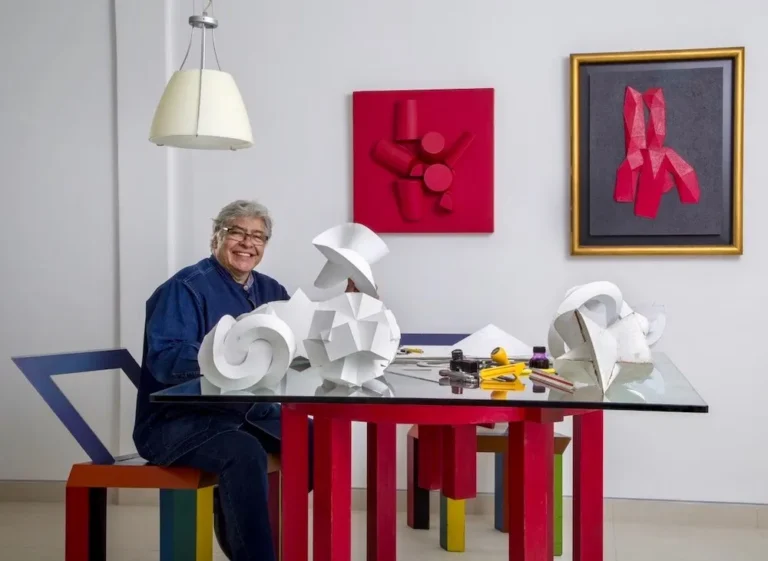
Anovia, Amman- In an exclusive interview, Anovia Magazine met with Latin America’s most influential contemporary Mexican sculptors, Sebastián who has reshaped the way we experience public space.
Born Enrique Carbajal González in Chihuahua, Mexico, Sebastián is regarded as one of Latin America’s most influential contemporary sculptors, he’s internationally acclaimed for monumental geometric works that turn steel and concrete into living parts of a city.
His sculptures don’t just sit in space, they interact with architecture, movement, mathematics, and civic identity, turning everyday streets and plazas into sites of dialogue between form and the people who pass through them.
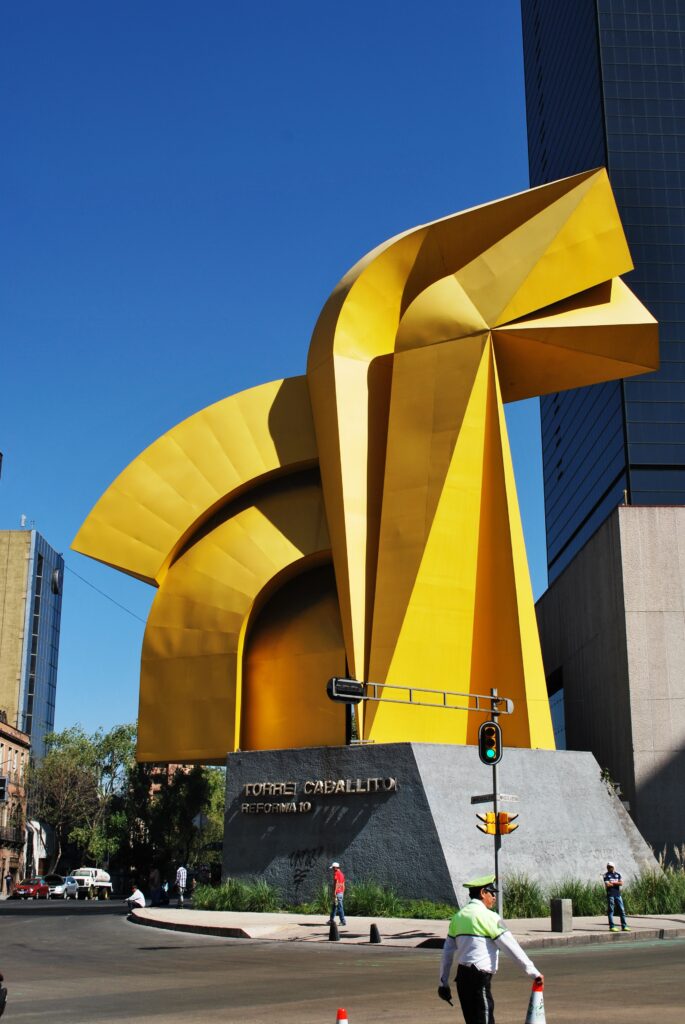
Anovia: Your monumental sculpture El Caballito has become your most recognized artistic signature worldwide. What does the horse symbolize within your artistic philosophy, and why did you consider Amman the right city to receive this symbol as a gift?
Sebastián: The horse represents movement, energy, dignity, and freedom. Since ancient civilizations, the horse has accompanied human history as a symbol of spiritual strength and transformation. In my case, El Caballito does not seek merely to represent an animal; it seeks to represent humanity’s ability to move toward the future while preserving its historical memory.
When a sculpture is installed in a city, it ceases to belong to the artist and begins to belong to the people. I believed Amman was a profoundly symbolic city to receive this work because Jordan is a place where history, spirituality, tradition, and modernity coexist. There are cities that naturally dialogue with monumentality and memory; Amman is one of them.
I also believe it is important for this piece to arrive as a gesture of friendship between Mexico and Jordan. Public art can become a silent bridge between cultures that may be geographically distant, yet emotionally close. That is the purpose of this sculpture’s presence in Amman.
I truly hope that Amman’s El Caballito becomes a lasting reference to the deep friendship between our peoples; a symbol that endures for generations as a place of encounter, a permanent reminder of everything Mexico and Jordan can continue building together: friendship, understanding, and mutual inspiration.
Anovia: Public sculpture often becomes part of a city’s identity and collective memory. When you imagine your sculpture in Amman many years from now, what kind of emotional or cultural dialogue do you hope it will generate among Jordanians and visitors alike?
Sebastián: I have always believed that public sculptures are like permanent inhabitants of a city. Over time, they cease to be “works of art” and become meeting points, personal memories, and emotional references.
I would like this work to inspire curiosity, contemplation, and a sense of belonging. I hope children grow up seeing it and feeling it as part of their everyday landscape. I hope visitors remember it as an inseparable image of Amman. And I hope Jordanians find in it a presence open to cultural dialogue.
Monumental art should not impose answers; it should open questions. If a sculpture manages to accompany the life of a city for decades, then it no longer belongs to the sculptor: it belongs to collective memory.
Anovia: Your works establish a unique connection between sculpture, mathematics, architecture, and urban space. How do you approach the relationship between sculpture and architecture when creating a piece intended for a living city rather than a gallery?
Sebastián: A city is a living organism. That is why a public sculpture cannot be conceived as an isolated object. I always study the architectural environment, human circulation, light, urban proportions, and even the speed at which people will experience the work.
For me, geometry is not cold; it is a form of universal harmony. Mathematics contains poetry. When I use geometric structures, I seek to create visual tensions that dialogue with architectural space and with the movement of the city.
In a gallery, the work exists within a protected space. In a city, however, the sculpture coexists with climate, noise, history, traffic, and human emotions. That is where it truly comes alive.
Anovia: If you have previously visited Amman or Jordan, what memories or impressions remain closest to you? And if not, what image or perception do you have of Jordan through history, culture, or conversations?
Sebastián: Although every personal experience carries intimate nuances, I have always seen Jordan as a land profoundly connected to human history and the continuity of civilizations. It is a country that occupies a symbolic place between East and West.
I am deeply impressed by the relationship between landscape, stone, and historical memory. There are places in the world where one feels that time remains visible, and Jordan possesses that quality. Petra, the desert, ancient architecture, and cultural traditions all project a sense of permanence and historical dignity.
I also perceive great human hospitality and a profound respect for culture. That allows an artist to feel close to a place even before arriving.
Anovia: Many artists begin with talent, but very few manage to transform that talent into a global artistic language. Looking back on your career, what were the defining moments that shaped you as an artist and refined your vision over the years?
Sebastián: I believe one of the most important moments was discovering that art could engage in dialogue with science and mathematics. I understood that geometry was not merely calculation: it was also emotion, structure, and philosophical thought.
Another decisive moment was understanding monumental scale. When a sculptor works for public space, he stops thinking only about himself and begins thinking about society, the city, and time.
In that sense, without a doubt, El Caballito in Mexico City marked a defining moment in my career. The installation of this work in 1992, at the emblematic site on Paseo de la Reforma where the equestrian statue of Charles IV by Manuel Tolsá had previously stood, represented a true transformation in my artistic journey. It not only propelled my work internationally, but also allowed me to understand the immense symbolic power that a public sculpture can acquire within the identity of a city. From that moment on, I understood that a monumental work can transcend the artist and become part of the collective memory of millions of people.
My travels and encounters with different cultures were also fundamental. Art changes when one understands that forms can carry different meanings depending on cultural context.
And of course, difficulties also shape the artist. Criticism and obstacles force one to strengthen a personal vision. I have often said that I would not be where I am today without the challenges I have faced over the years, because resistance also refines creative character.
Anovia: Your sculptures are known for transforming geometry into something emotional and human. How do you balance precision and engineering with imagination and sensitivity in the creative process?
Sebastián: For me, there is no contradiction between engineering and sensitivity. Emotion also has structure. Nature itself functions through mathematical patterns and yet produces beauty.
When I work on a sculpture, a poetic intuition appears first: an emotion, an energy, or a spatial idea. Then comes the rational process, where geometry, physics, and engineering intervene to make that vision possible.
Technique must serve emotion, never the other way around. If a work is perfectly calculated but transmits nothing human, then it becomes merely a technical object. I seek for even the most geometric forms to possess an emotional vibration.
Anovia: Many young people around the world dream of creating something “monumental,” yet they fear limitations, rejection, or failure. What would you say to dreamers who have ambitious visions but still doubt that those visions can truly become reality?
Sebastián: I would tell them that the monumental does not begin with the size of a work, but with the scale of an inner vision.
All important projects seem impossible at the beginning. If one waits for absolute certainty before creating, one will never accomplish anything meaningful. Fear, rejection, and failure are natural parts of the creative process.
I grew up in a small town in northern Mexico and never imagined that my sculptures would reach different parts of the world. What transforms a vision into reality is not only talent; it is persistence.
Art requires discipline, imagination, and emotional resilience. One must learn to coexist with criticism without abandoning one’s own voice. The greatest ideas often make people uncomfortable before they are understood.
And something very important: one should never be afraid of thinking big. Human imagination always reaches farther than the limitations of the present.