Dedicated to the Holy Apostles and Commemorated in a Dedicatory Inscription
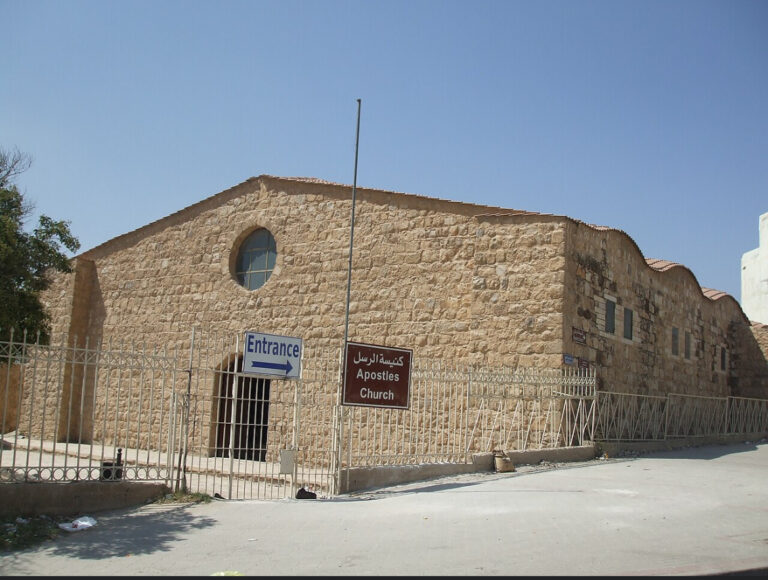
Madaba, Anovia – On the southern slope of ancient Madaba stands the Church of the Apostles, a Byzantine landmark whose remarkable mosaic floor reveals far more than a sacred space, offering a glimpse into the city’s environment, artistic tradition and connections with the wider world.
Yet, as Khaled Al-Hawawreh, Director of Antiquities in Madaba Governorate, explained, the church is only one chapter in a much longer story of human settlement in Madaba.
“Madaba’s tell witnessed human settlement from very early periods, beginning in the Bronze Age around 3300 BC, continuing through the Iron Age, the Nabataean and Roman periods, and into the Byzantine era,” he explained.
“Madaba was a flourishing city, with churches, important buildings and a strong artistic tradition.”
That tradition is still visible underfoot.
The church, discovered in 1902 by Father Manfredi, the Italian parish priest of Madaba’s Latin Church, and scientifically excavated in 1967, follows a basilica plan, with an outer courtyard and well, three entrances, side aisles and a central nave. Yet architecture alone is not what makes the site memorable.
“What distinguishes the Byzantine sites of Madaba is their mosaic floors,” Al-Hawawreh said, adding that “the artist was a local Madaba artist, not someone brought from outside.”“What distinguishes the Byzantine sites of Madaba is their mosaic floors,” Al-Hawawreh said, adding that “the artist was a local Madaba artist, not someone brought from outside.”
The artist even left his name on the mosaic floor: Salamianos, or Salman of Madaba.
At the centre of the nave appears the personification of the sea, one of the church’s most striking images, surrounded by fish and marine life. Its roots lie in the classical Roman visual world, but here the image was given a different meaning.
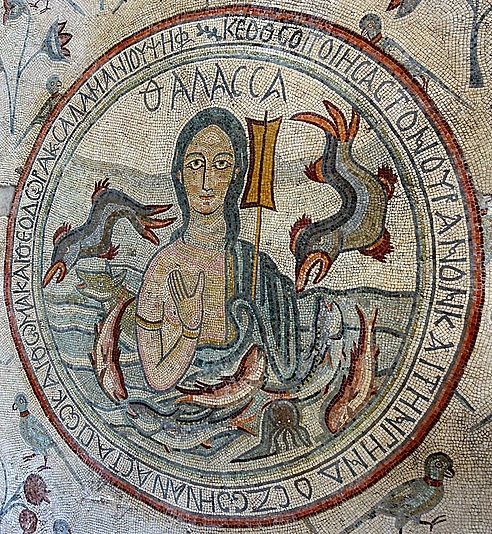
“The artist drew from an older Roman cultural heritage, but presented it in a Christian artistic context,” Al-Hawawreh explained. “It was no longer an object of worship. It became part of the decorative language of Christian art.”
Around it, the mosaics open a window onto Byzantine Madaba, with animals, birds, plants, flowers and geometric forms spread across the floor. Some belonged to the local environment; others, such as dolphins and marine creatures, clearly did not.
For Al-Hawawreh, that detail was significant.
“It shows that the people of Madaba were connected with other places. They had seen animals and plants elsewhere and brought those images into the art of their own city.”
The church was dedicated to the Holy Apostles, as confirmed by a dedicatory inscription discovered at the site.
The nearby chapels add further layers, with mosaics depicting animals, trees, flowers, birds and intricate geometric and vegetal patterns.
Seen together, the floor becomes more than an archaeological masterpiece. It is a visual record of Byzantine Madaba as a Christian, prosperous and artistic city, deeply connected to the wider world.
“This was Madaba in the Byzantine period,” Al-Hawawreh said, “a city flourishing with its nature, its flowers, its churches and its buildings. The artist wanted to communicate that through this beautiful image.”
Today, the protective structure surrounding the archaeological remains helps ensure that this extraordinary visual record survives.
The Church of the Apostles preserves a world centuries removed from our own, yet its mosaics bring Byzantine Madaba remarkably close: a city of faith and artistry whose people looked beyond their own landscape and translated what they knew of the wider world into stone.