By Rula Samain
Anovia, Amman – In a region growing increasingly complex and unsettled, there remain places that retain their spiritual and human depth, transcending their geographical presence to become part of the region’s collective memory and identity.
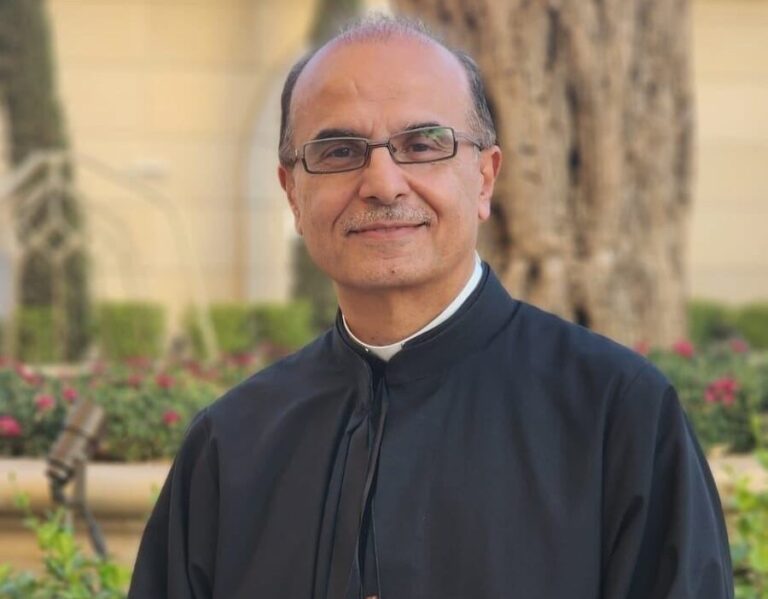
Among these places stands Jordan, which, for Father Joseph Soueid, Patriarchal Vicar of the Maronite Church, is far more than a country embracing sacred religious sites.
Father Sweid describes it as a “spiritual oasis” carrying a national, cultural, and human project capable of reintroducing the East to the world through the gateway of peace, religious pilgrimage, and profound human experience.
In a conversation marked by passion, vision, and faith, Father Sweid linked religious tourism with national identity, and faith with culture, youth, and the economy, believing that Jordan today possesses a historic opportunity to become one of the world’s leading Christian pilgrimage destinations, beginning from the Jordan River, the site that witnessed the baptism of Jesus Christ and the beginning of the Christian message.
Speaking to Anovia Magazine, he stated that “Jordan lacks nothing to become one of the most important Christian pilgrimage destinations in the world,” adding that “this land carries the message, carries peace, and preserves the region’s true spiritual memory.”
Yet Father Sweid does not speak of tourism merely as an economic sector, but as an integrated civilizational and spiritual project through which Jordan can address the world in a different language, at a time when people are increasingly searching for “experience” and meaning rather than fleeting travel.
“The visitor today does not simply want to take a photograph and leave. They seek a complete spiritual and human experience; to feel the place, and to return carrying a new sense of meaning.”
Father Sweid also noted that the role played by Anovia Magazine goes beyond the traditional concept of tourism promotion, contributing instead to shaping a national and spiritual narrative that reflects Jordan’s human and civilizational image.
He viewed the magazine as presenting Jordan as a space for peace, dialogue, and spiritual experience, within a cultural and tourism project whose dimensions extend beyond economics into a broader human and cultural vision.
At the Jordan River, the story began, he said.
For Father Sweid, it is impossible to speak about a global pilgrimage project without pausing at the Jordan River, which he considers the very point where the message began.
The Baptism Site, as he describes it, carries not only religious value, but also offers visitors a living spiritual experience that has preserved its original simplicity despite the passing of two thousand years.
“What distinguishes Jordan is that the state preserved the spirit of the place. It did not transform the Baptism Site into a cold commercial space, but kept it close to its original nature, as though the visitor truly returns to the time of John the Baptist.”
However, Father Sweid believes that the next phase should move beyond the concept of merely “visiting a site” toward building a “complete pilgrimage experience,” similar to the major global pilgrimage destinations of Fátima in Portugal, Lourdes in France, and Santiago de Compostela in Spain.
Explaining his vision, he says that pilgrims should not only visit the place, but live its symbolism as well, from white garments symbolizing purity, to candles, incense, music, and even food connected to the spiritual narrative.
“Pilgrimage around the world is built on both sensory and spiritual experience. People want to feel they have entered an inner journey, not merely a tourist trip.”
Recalling the figure of John the Baptist, Father Sweid believes that the region today is in need of a renewed spiritual discourse carrying the meanings of mercy, purity, and peace instead of division and fear.
He believes Jordan has the ability to present this message to the world, rooted in its authentic spiritual heritage.
At the heart of this vision stands Saint Charbel Church in Amman, which Father Sweid considers a key stop within Jordan’s religious and tourism map, especially given the strong spiritual connection many Lebanese feel toward Saint Charbel.
“There is a genuine Lebanese affection for Jordan, and when Lebanese visitors come to Saint Charbel Church, they feel deeply connected to their spiritual and cultural roots.”
He explains that the church is no longer merely a place of worship, but has become part of the visitor’s spiritual and tourism experience, particularly amid growing interest in religious tourism across the region.
“If we succeed in integrating Saint Charbel Church into the official tourism map, we are not merely adding another religious stop, but building a spiritual and cultural bridge between Jordan and Lebanon.”
Father Sweid also reflects on Lebanon as a country where tourism continues to endure despite crises, believing that Jordan too can establish a unique spiritual tourism model based not only on infrastructure, but on “narrative.”
“The world is not only searching for hotels and flights, but for stories, and Jordan possesses one of the most powerful spiritual narratives in history.”
With visible enthusiasm, Father Sweid revealed details about the “Jubilee 2030” project, which he considers an exceptional opportunity to launch Jordan as a global pilgrimage destination.
He noted that he has already presented a comprehensive vision to several official bodies and national figures, including the Senate, Prince Ghazi bin Muhammad, and Prime Minister Dr. Jaafar Hassan.
“This opportunity may never come again. If we do not begin now, we will lose a very important historical moment.”
The project aims to establish an integrated pilgrimage route beginning at the Jordan River and extending to Mount Nebo and other sacred sites, within an experience that combines faith, culture, and Jordanian hospitality.
Father Sweid stresses that the project’s success requires genuine belief in the vision, not merely conventional plans.
“Jordan possesses the narrative… and it must tell it to the world in the way it deserves.”
Despite his extensive discussion of sacred sites and spiritual vision, Father Sweid repeatedly returns to youth as the decisive factor in the success of any future project.
“Officials can draft plans, but it is the youth who create the image and the modern narrative. They create the content, the videos, and the language understood by the world today.”
He revealed that the project includes engaging universities, schools, and youth organizations to prepare a generation specialized in religious tourism and spiritual-cultural content creation.
He also praised the role of His Royal Highness Crown Prince Al Hussein bin Abdullah II in empowering Jordanian youth and opening doors for their initiatives and talents.
“The Crown Prince understands the language of youth and believes in their abilities. This is essential if we truly want to launch a project on the scale of Jordan.”
By the end of the conversation, it became evident that Father Joseph Soueid does not view religious tourism as merely an economic sector or a seasonal activity, but as a project capable of reintroducing Jordan to the world through its spiritual, cultural, and human identity.
While countries compete to create tourist attractions, he believes Jordan possesses something deeper than all of that, “the narrative”; one that begins at the river, travels through history, and carries the values of peace, coexistence, and openness in a region that today needs these messages more than ever.
Father Joseph concluded that Jordan does not need to invent a new story, the story has existed for two thousand years, and what it needs is simply to believe in it more deeply and tell it to the world in the way it deserves.