

By Dr. Yousief Zreagat
Manager of the Old Testament Research Centre
The history of Jordan cannot be fully understood without examining the civilizations that flourished on its land and contributed to the religious, cultural, and economic development of the region. Among the most remarkable examples are the cities of the Decapolis, an ancient network of Greco-Roman urban centres whose influence extended beyond their political boundaries and whose significance is preserved in both historical writings and the New Testament.
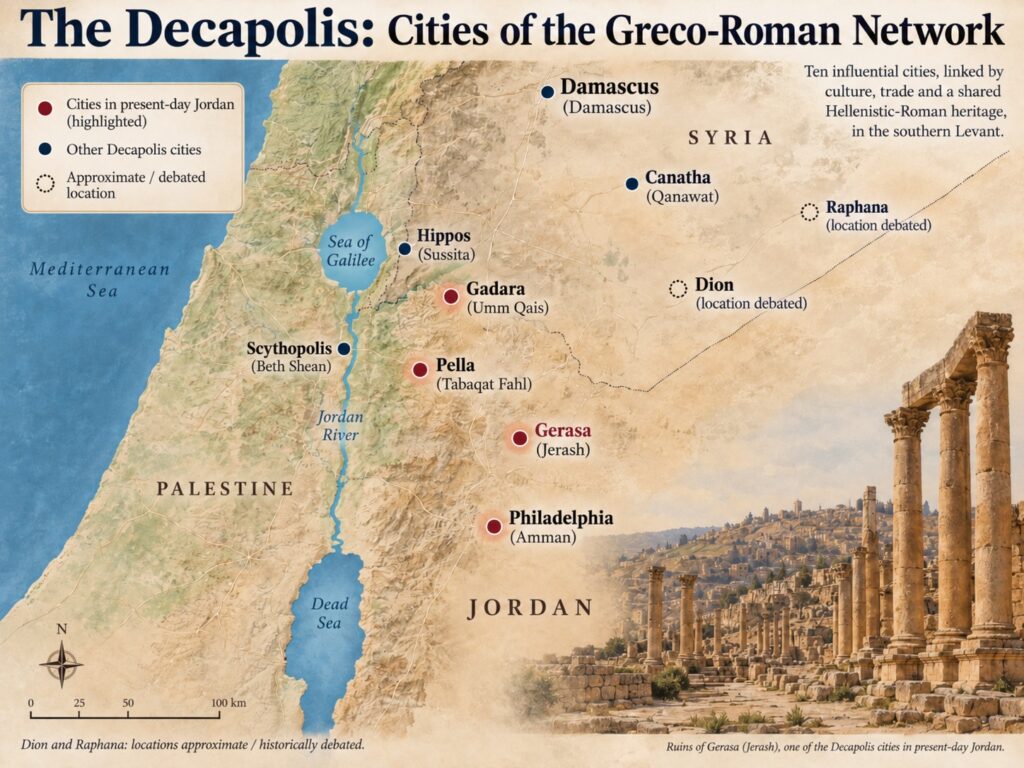
The term Decapolis comes from the Greek words deka, meaning ten, and polis, meaning city. It traditionally referred to a group of ten predominantly Gentile cities situated mainly east of the Jordan River and southeast of the Sea of Galilee. These cities developed as important centres of trade, administration, architecture, and cultural exchange, particularly during the Hellenistic and Roman periods.
Although the Decapolis is often described as a league of ten cities, its precise political structure and membership remain subjects of historical discussion. What is clear, however, is that these cities enjoyed varying degrees of civic autonomy and shared elements of Greek and Roman urban culture while maintaining connections with the surrounding Semitic populations.
The significance of the Decapolis becomes particularly evident through its references in the New Testament. In Matthew 4:25, the Gospel records that large crowds followed Jesus Christ from Galilee, the Decapolis, Jerusalem, Judea, and beyond the Jordan River. This geographical description demonstrates the broad reach of His ministry and the movement of people across territories with different religious and cultural traditions.
The Gospel of Mark provides further testimony. In Mark 5:20, following the healing of a man in the region of the Gerasenes, the man travelled throughout the Decapolis proclaiming what Jesus had done for him. This account places the Decapolis within the geographical setting of the early proclamation of Christ’s works. Similarly, Mark 7:31 describes Jesus travelling through the region of the Decapolis toward the Sea of Galilee, where He healed a man who was deaf and had difficulty speaking.
These passages are significant not merely because they mention geographical locations, but because they demonstrate that the Decapolis formed part of the wider social and cultural landscape in which the events of the Gospels unfolded. They also highlight the interconnectedness of communities living across the Jordan River and the surrounding regions.
Historical writings provide another perspective on these cities. The Roman naturalist Pliny the Elder, writing in the first century AD, identified ten cities in his encyclopedic work Natural History: Scythopolis, Philadelphia, Gadara, Hippos, Gerasa, Pella, Dion, Raphana, Canatha, and Damascus. Importantly, Pliny himself acknowledged that ancient writers did not entirely agree on which cities belonged to the Decapolis.
Several of these cities are located in present-day Jordan. Philadelphia became modern Amman; Gerasa is today’s Jerash; Gadara is associated with Umm Qais; and Pella with Tabaqat Fahl in the northern Jordan Valley. Together, they preserve archaeological evidence of the region’s urban sophistication, including colonnaded streets, theatres, temples, public squares, water systems, and, in later centuries, churches.
The historian Flavius Josephus also referred to the Decapolis and several of its cities in his writings, providing evidence of their importance during the Roman period. His accounts, alongside those of Pliny and later geographers, help establish the Decapolis as a historically significant regional network rather than simply a collection of archaeological sites.
Interestingly, Pliny’s observations extended beyond geography and political history. In Book XV of Natural History, he discussed agricultural products and specifically referred to the olives of the Decapolis. He described them as exceptionally small, comparable in size to capers, yet highly valued for their flesh and suitability for eating rather than oil production.
This detail may appear minor, but it reveals an important aspect of everyday life. The Decapolis was not sustained by monumental architecture alone. Its prosperity also depended on agriculture, food production, regional exchange, and the economic activities of its inhabitants. The appreciation of its olives in Roman literature suggests that agricultural identity and local products were already part of the region’s wider reputation nearly two thousand years ago.
Today, the legacy of the Decapolis offers Jordan an opportunity to present a more integrated understanding of its history. The archaeological remains of Jerash, Umm Qais, Amman, and Pella should not be viewed solely as individual destinations. They represent interconnected chapters of a civilization that participated in the political, commercial, and religious developments of the ancient Near East.
Equally important is the relationship between these cities and the biblical narrative. Recognizing the Decapolis as part of the geographical context of the New Testament enriches our understanding of Jordan’s place within the wider history of Christianity, while respecting the different historical and religious traditions that shaped the region.
The enduring value of the Decapolis lies in this combination of history, faith, culture, and human activity. Its cities remind us that ancient Jordan was not isolated from the civilizations around it. It was an active participant in their development, a crossroads through which people, goods, beliefs, and ideas travelled.
Preserving and interpreting the Decapolis heritage, therefore, is more than an archaeological responsibility. It is an opportunity to communicate Jordan’s historical contribution to the development of regional civilization and to connect the physical remains of the past with the stories that continue to give them meaning today.